

Creating content is only the first step. The real challenge is building the consistency needed for that content to grow, reach people, and eventually deliver results.
Most small business owners don’t struggle because they have absolutely nothing useful to say. In fact, you probably answer valuable customer questions all day long without even realizing that those answers could become content.
The problem usually looks more like this:
You publish a few social media posts.
Maybe you write a blog.
Then you get busy.
A week goes by.
Then two weeks.
Before you know it, three months have passed since your business posted anything.
Sound familiar?
If so, you’re definitely not alone.
Running a small business is already a full-time job– and usually several other jobs piled on top of it. You’re helping customers, managing employees, answering calls, handling paperwork, solving problems, and trying to grow. Sitting down every morning to invent a brand-new marketing idea probably isn’t high on your list.
That’s why great content marketing isn’t built on constantly coming up with brilliant new ideas.
It’s built on having a simple, realistic system you can maintain.
In this guide, we’ll show you how to build that system using pillar content, content repurposing, and a repeatable publishing framework that helps you answer customer questions consistently and build trust over time.
No complicated marketing theories.
No pressure to become a full-time content creator.
Just a practical framework that helps your business create useful content, stay visible, and build trust over time.
Build Your Content Strategy Around Pillar Content
One of the biggest reasons businesses struggle with content is that they treat every post like a separate project instead of building around a larger strategy.
Monday comes around, and someone asks:
“What should we post this week?”
Everyone stares at each other.
Eventually, somebody suggests a holiday graphic, a picture of the office dog, or another post telling people to call for a free estimate.
None of those ideas are necessarily bad.
The problem is that there’s no larger strategy holding everything together.
Every week starts with a blank page.
Every post requires another brainstorming session.
After a while, everyone gets tired of trying to invent something new.
This is where pillar content can simplify your entire content strategy.
What Is Pillar Content?
Pillar content is a main, substantial piece of content built around animportant topic your customers care about.
Think of it as the foundation of a house.
You build the foundation first. Then the walls, rooms, doors, and everything else have something solid to connect to.
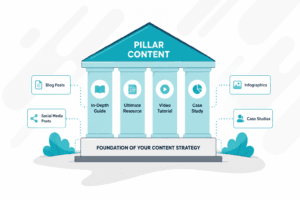
A pillar piece might be:
- An in-depth blog article
- A podcast episode
- A long-form video
- A detailed customer guide
- A webinar
- A comprehensive FAQ page
The important thing isn’t the format.
What matters is that it thoroughly explores one useful topic and gives you plenty of smaller ideas to use later.
For example, imagine you own an HVAC company in Grand Rapids.
You could create one pillar article called:
A Michigan Homeowner’s Complete Guide to Furnace Maintenance
That article could cover:
- How often to replace a furnace filter
- Warning signs that a furnace needs repair
- What furnace maintenance includes
- How Michigan winters affect heating systems
- When to repair versus replace a furnace
- Ways to reduce winter heating costs
Now you no longer have only one piece of content.
You have six or more smaller topics that can be used throughout your marketing.
That’s the power of pillar content.
Pillar Content Gives Your Marketing Direction
Without pillar content, your marketing can feel scattered, with each post standing on its own instead of supporting a larger goal.
One week, you post about a service.
The next week, you share a motivational quote.
Then you promote a sale.
Then you disappear for a month because nobody knows what to post next.
Pillar content gives you a central topic to build around.
Instead of asking:
“What random thing should we post today?”
You can ask:
“What useful idea can we pull from this month’s pillar topic?”
That is a much easier question to answer.
It also creates a more organized experience for your audience.
If you spend a month discussing furnace maintenance, for example, customers begin to associate your business with heating expertise. They see related tips, explanations, videos, and answers instead of a collection of unrelated posts.
Your content starts reinforcing itself.
One post introduces the topic.
Another answers a common question.
Another clears up a misconception.
Another points readers toward the complete guide.
Together, those pieces create a clear message:
“These people know furnaces, and they’re genuinely trying to help me understand mine.”
That’s far more valuable than posting simply because your calendar says you’re supposed to post something.
Pillar Content Can Work for Almost Any Local Business
This approach isn’t limited to marketing companies or businesses with professional writers.
- A lawn care company could create a pillar guide about preparing a Michigan lawn for spring.
- A massage studio could create a beginner’s guide to choosing the right type of massage.
- A roofing contractor could explain everything homeowners should know about replacing a roof.
- A local restaurant could create a guide to planning a private dining event.
- A dentist could publish a complete explanation of dental implants.
- A retail store could create a holiday gift guide featuring different products for different customers.
Each pillar piece gives the business a large, useful topic that can be broken into smaller content later.
And here’s the best part:
You probably already know most of the information.
Chances are, you’re already explaining these topics to customers every day.
The pillar system simply turns that knowledge into an organized marketing framework.
If you’re still learning the fundamentals, check out our guide to content marketing for local businesses for practical advice on creating useful content that helps your business get found.
Don’t Confuse “Pillar” With “Enormous”
A pillar piece should be thorough, but that doesn’t mean it has to become a 20,000-word textbook.
The goal is usefulness.
Your pillar content should answer the biggest questions someone has about a topic and help them understand what to do next.
For one topic, that might require a 2,500-wordguide.
For another, it might be a 15-minute video.
For another, it could be a detailed FAQ page.
Don’t make content longer just to make it longer.
Make it complete enough that the customer feels helped.
That’s the standard that matters.
Create a Few Repeatable Content Pillars
In addition to creating individual pillar pieces, it can help to identify a few broad categories your business will discuss regularly.
For a local landscaping company, those categories might be:
- Lawn care education
- Seasonal maintenance
- Project examples
- Common landscaping mistakes
- Local Michigan growing conditions
For a massage studio, they might be:
- Pain and tension relief
- Different massage services
- Wellness education
- Client preparation and aftercare
- Studio and therapist stories
These categories become your content lanes.
You still have plenty of freedom, but you’re no longer driving around without directions.
When you need an idea, you can return to one of your established topics and ask:
- What question can we answer?
- What misconception can we correct?
- What example can we share?
- What seasonal advice would help?
- What customer story could we tell?
Suddenly, content creation becomes much less intimidating.
Turn One Content Idea Into Multiple Pieces
Here’s a truth that can save small business owners an enormous amount of time:
You probably don’t need more ideas– you need a better system for using the ones you already have
A lot of businesses treat content like a disposable product.
They spend hours writing an article, publish it once, share it once, and then immediately start worrying about what to create next.
That’s like cooking an entire Thanksgiving dinner, eating one forkful, and throwing the rest away.
You put in the work.
Get some mileage out of it.
What Is Content Repurposing?
Content repurposing simply means taking one useful idea and adapting it into different formats.
You aren’t mindlessly copying and pasting the exact same thing everywhere.
You’re presenting the same core lesson in different ways so it can reach people on different platforms.
Let’s return to the furnace maintenance guide.
That one pillar article might become:
- A Facebook post about furnace filters
- A short video explaining strange furnace noises
- An email with a winter maintenance checklist
- An Instagram graphic showing repair warning signs
- A Google Business Profile post about seasonal tune-ups
- An FAQ answering how often a furnace should be serviced
- A customer handout explaining what a maintenance appointment includes
One idea becomes an entire content campaign.
Each piece can direct people back to the larger pillar article when they want more information.
Start With the Way You Naturally Think
Not everyone enjoys sitting at a desk and typing a blog from scratch.
That’s okay.
Your best ideas might happen:
- While walking
- While driving between appointments
- During a conversation with an employee
- Immediately after answering a customer question
- While inspecting a project
- During a sales meeting
When an idea comes to you, record a quick voice memo.
Don’t worry about making it polished.
Just explain the idea the same way you would explain it to a customer.
For example:
“People keep asking whether they should completely replace a brown lawn. Usually, the answer is no. We should explain the three things we check before recommending replacement.”
That short recording could become:
- A blog section
- A social post
- A video script
- An email tip
- A frequently asked question
You don’t need to wait for the perfect writing environment.
Capture the knowledge when it appears.
You can organize and polish it later.
One Customer Question Can Fill an Entire Week
Imagine you own a roofing company, and a customer asks:
“How long does a roof replacement take?”
You could turn that one question into:
- Monday: A short Facebook post giving the average answer.
- Tuesday: A video explaining what can delay a roofing project.
- Wednesday: An email about preparing your home before the crew arrives.
- Thursday: A photo showing a project in progress.
- Friday: A link to a complete article about the roof replacement process.
That’s a week of useful content built from one real question.
No desperate brainstorming.
No random filler.
No staring at a blinking cursor while wondering whether National Donut Day is somehow relevant to roofing.
Just one helpful idea presented in several ways.
Different Customers Prefer Different Formats
Some people prefer reading detailed blogs.
Others would rather watch a 60-second video.
Some regularly engage with email updates.
Others spend their time on Facebook or Instagram.
Repurposing allows you to meet customers where they already are.
The person who never reads your blog may watch your video.
The person who misses your social post may open your email.
The person who ignores your email may find your article through Google six months later.
You don’t need a completely different message for every platform.
You need different doorways into the same helpful information.
Build a Simple Repurposing Checklist
After creating a pillar piece, ask:
- Can this become three to five social posts?
- Is there a section that would make a useful email?
- Can someone explain one point in a short video?
- Are there quotes or tips that could become graphics?
- Can we add part of this information to our FAQ page?
- Could this become a checklist or downloadable guide?
- Is there an older related article we should update and link to?
This checklist turns content repurposing into a repeatable process instead of an occasional afterthought.
It also helps your business stay consistent without requiring your team to produce something brand new every day.
Consistency Matters More Than Posting Frequency
A lot of business owners assume successful content marketing means posting constantly.
Three times a day.
Six times a day.
On every platform.
Following every trend.
During every waking moment.
That sounds exhausting because it is exhausting.
And for most local businesses, it’s completely unnecessary.
Content consistency does not mean filling the internet with as much material as possible.
It means choosing a reasonable schedule and sticking to it.
Publishing one useful post every week for a year is usually far more valuable than publishing three times a day for two weeks and then disappearing.
Choose a Pace You Can Actually Maintain
Let’s say Business A publishes 20 social posts during the first two weeks of January.
Then the owner gets busy.
The business doesn’t post again until April.
Business B publishes one helpful post every Thursday.
Nothing flashy.
Nothing excessive.
Just one useful post every week.
By the end of the year, Business B has published more than 50 pieces of consistent content.
Business A had a burst of activity and then went silent.
Which one built more momentum?
Which one gave customers more opportunities to remember the business?
Which one developed a sustainable habit?
Business B wins.
That doesn’t mean once a week is the perfect schedule for everyone. Your business might be able to maintain three posts each week, one monthly article, and a monthly email.
Another business might begin with one social post a week.
The right schedule is the one you can realistically continue without sacrificing quality or burning yourself out.
A Forbes Agency Council discussion about content consistency makes a similar point: Businesses need a schedule they can follow, along with a consistent brand voice and customer experience.
Customers Usually Need More Than One Interaction
Most customers don’t see one social post and immediately become loyal buyers.
They might:
- Notice one post
- See a video two weeks later
- Read an article after searching Google
- Hear your name from a friend
- Visit your website
- Receive an email
- Finally contact you
Each interaction makes your business a little more familiar.
And familiarity matters.
Think about the businesses you trust.
You probably didn’t develop that trust from one advertisement.
You saw them repeatedly.
You heard positive things.
You had several good interactions.
You gradually became comfortable with them.
Content works the same way.
One piece may not close a sale.
Its job might simply be to create the next positive interaction.
Then the next piece continues the relationship.
Over time, consistent content helps move someone from:
“I’ve never heard of this company.”
To:
“I think I’ve seen them before.”
Then:
“They seem to know what they’re talking about.”
And eventually:
“I’m going to call them.”
That process rarely happens overnight.
But it happens much more easily when your business keeps showing up.
Content Builds Momentum Over Time
One of the biggest challenges with content marketing is that results often take time.
You publish an article.
Seven people read it.
Two of them might be your employees.
You post a video.
It gets 43 views.
Nothing explodes.
That can be discouraging.
But early content is doing more work than the numbers may show.
You’re learning what your customers respond to.
You’re improving your writing or video skills.
You’re building a library of helpful information.
You’re giving search engines more opportunities to understand your business.
You’re establishing habits.
Then something interesting begins to happen.
One article starts attracting visitors through search, which leads them to explore other pages on your website.
A social post gets shared.
A customer mentions a video during a sales call.
An old email brings someone back to your website.
The content begins supporting other content.
That’s momentum.
A useful article can continue working long after you publish it. A video can be discovered months later. An FAQ can answer hundreds of customer questions without requiring your team to repeat the same explanation every time.
This is why consistency matters so much in small business marketing.
You’re not just publishing individual posts.
You’re building a collection of assets that can continue helping your business.
For another look at how a long-term publishing rhythm supports growth, read this guide to consistent content creation.
Create a Marketing Framework You Can Maintain

Good intentions are not a marketing system.
Saying “we should post more” is not a strategy.
Waiting until someone feels inspired is not a dependable content plan.
You need a marketing framework simple enough to follow during busy weeks– not just when business is slow and everyone has extra time.
Start With One Platform
You do not need to master every platform at once.
Pick the one that makes the most sense for your audience and your resources.
For many local businesses, that may be:
- A website blog
- YouTube
Choose one primary platform and build a dependable habit there.
That doesn’t mean you can never share content elsewhere.
It simply means one platform becomes your starting point instead of trying to maintain six half-abandoned accounts.
A commercial service company may get more value from LinkedIn and email.
A restaurant or salon may benefit from Facebook and Instagram.
A business targeting people who are actively searching for answers may make its website blog the foundation.
Go where your customers are and where your content fits naturally.
Choose a Repeatable Schedule
Let’s keep this realistic.
Your first content schedule might be:
- One pillar article each month
- One social post each week
- One monthly email
Or:
- One helpful video every other week
- Two short posts pulled from each video
- One monthly customer story
Or even:
- One useful post every Tuesday
That’s enough to begin.
Once the habit is established, you can increase your output.
It’s much easier to grow a functioning system than to rescue a complicated system everyone has stopped using.
Use a Simple Monthly Framework
Here’s an example for a local service business:
Week 1: Answer a customer question
Explain something customers frequently ask before buying.
Week 2: Share an example
Show a project, customer story, or real-world result.
Week 3: Teach something useful
Offer a tip that helps customers avoid a problem or make a better decision.
Week 4: Show the people behind the business
Introduce an employee, share a community event, or offer a behind-the-scenes look.
Now you have a basic monthly plan.
No daily panic.
No complicated spreadsheet with 400 empty boxes.
Just four clear types of content you can repeat.
Treat Content Like Planting a Garden
Content creation is a lot like planting a garden.
You don’t plant seeds on Monday, dig them up on Wednesday, and declare gardening a scam because you don’t have tomatoes yet.
You prepare the soil.
You plant.
You water.
You keep showing up.
For a while, not much seems to happen.
Then you begin seeing growth.
Content marketing works similarly.
The articles, videos, posts, and emails are seeds.
Some will grow faster than others.
Some may not perform the way you expected.
But when you consistently create useful content, learn from the results, and improve your approach, growth begins to compound.
The hardest part is continuing to water the garden before you can see the results.
That’s where most businesses stop.
They publish for a month, don’t immediately see a flood of sales, and decide content doesn’t work.
In reality, they may have stopped just as the foundation was being built.
Great content marketing requires enough patience to let good work accumulate.
Assign Ownership
One practical reason content becomes inconsistent is that nobody actually owns it.
Everyone agrees the business should publish.
But who writes the first draft?
Who approves it?
Who creates the image?
Who puts it on the website?
Who shares it?
If the answer is, “We all kind of handle it,” the real answer is usually, “Nobody handles it.”
Give each step an owner.
Even a two-person company can define a simple workflow:
- One person collects ideas.
- One person creates the first draft.
- One person reviews it.
- One person publishes it.
One person may handle several of those steps, and that’s fine.
The point is that everyone knows what happens next.
A repeatable process removes a surprising amount of stress.
Need more guidance? Watch our podcast conversation for additional content marketing tips.
Create Content That Answers Real Customer Questions
You do not need to lock yourself in a conference room for six hours to brainstorm content ideas.
Your customers are already giving you ideas.
They do it every time they ask:
- How much does this cost?
- How long will this take?
- What happens during the process?
- Which option is right for me?
- Why do I need this?
- Can I do this myself?
- What could go wrong?
- How is your service different?
- What should I do before my appointment?
- What happens after the work is finished?
These questions are content.
And they’re often better than the ideas a marketing team invents from scratch because they come directly from the people you’re trying to reach.
Pay Attention to Questions Before the Sale
The questions people ask before buying are especially valuable.
They reveal what customers need to understand before they feel comfortable moving forward.
For a massage studio, those questions might be:
- What should I wear?
- Does a massage hurt?
- Which massage should I book?
- How early should I arrive?
- How often should I schedule appointments?
For a contractor:
- Do I need a permit?
- How long will the project take?
- Do I need to leave the house?
- What happens if the weather is bad?
- How much should I budget?
For a marketing agency:
- How long does SEO take?
- How much should I spend on ads?
- Do I need a new website?
- Can I handle social media myself?
- How do I know whether marketing is working?
Every question represents uncertainty.
Helpful content removes that uncertainty.
When your business helps someone feel informed and comfortable, trust begins to grow.
Build a Customer-Question Bank
Create one shared document.
It doesn’t need to be fancy.
Every time a customer asks a useful question, add it to the document.
Encourage your team to contribute.
Your receptionist hears questions.
Your salespeople hear objections.
Your service team sees common mistakes.
Your technicians notice recurring problems.
Your customer support team knows where people get confused.
All of those people are sitting on content ideas.
After a month, you may have dozens of topics.
Organize them into categories such as:
- Pricing
- Process
- Service comparisons
- Common problems
- Preparation
- Aftercare
- Local concerns
- Misconceptions
- Frequently made mistakes
Now you have a content library based on actual customer needs.
Answer the Question Honestly
This is where some businesses get nervous.
They want to create content, but they don’t want to provide a direct answer.
So, an article titled “How Much Does Lawn Care Cost?” spends 1,000 words saying:
“Every lawn is different. Contact us for a quote.”
Technically, that’s an answer.
It’s just not a very helpful one.
You may not be able to give one exact price, but you can explain:
- The typical range
- What affects the price
- What is normally included
- Why one property costs more than another
- What customers should ask when comparing quotes
Helpful content respects the reader’s question.
You can be honest without promising something you can’t guarantee.
In fact, transparency often makes customers more likely to contact you because they know what to expect.
Use Questions From Different Stages of the Customer Journey
Not every question comes from someone who is ready to buy.
Some people are just realizing they have a problem.
Others are comparing possible solutions.
Some are ready to choose a provider.
Create content for each stage.
Early-stage questions:
- Why is my basement damp?
- What causes shoulder tension?
- Why is my website traffic dropping?
Comparison questions:
- Sump pump versus waterproofing system
- Deep-tissue versus Swedish massage
- SEO versus paid advertising
Buying questions:
- How much does the service cost?
- How long does it take?
- What should I expect during the appointment?
Together, these topics help customers throughout the decision-making process.
Your content doesn’t just appear at the finish line.
It helps guide people toward it.
For more ideas about turning useful content into customer opportunities, read our lead-generation content marketing tips.
Great Content Marketing Builds Trust Over Time
It’s easy to judge content by the most visible numbers.
Views.
Likes.
Comments.
Followers.
Website traffic.
Those numbers can be useful, but they don’t tell the whole story.
A post with 5,000 views may generate no meaningful business.
An article with 50 highly relevant local readers might produce three strong leads.
The largest number isn’t always the most valuable result.
Ask Better Questions About Your Content
Instead of only asking, “How many people saw this?” ask:
- Did it answer a real customer question?
- Did the right people see it?
- Did anyone visit another page afterward?
- Did a customer mention it during a call?
- Did it help explain our service?
- Did it support a sale?
- Can our team reuse it?
- Will it continue being useful six months from now?
That gives you a better picture of your content’s performance.
Great content marketing doesn’t exist simply to make a dashboard look impressive.
It should help customers and support the business.
Trust Comes From Repeated Positive Interactions
One article probably won’t make someone trust you completely.
Neither will one email or social post.
Trust builds gradually.
Every helpful interaction makes a small deposit.
You answer a question honestly.
Deposit.
You explain pricing clearly.
Deposit.
You share a useful local tip.
Deposit.
You show a real project.
Deposit.
You introduce your team.
Deposit.
Over time, those positive interactions add up.
Then, when the customer finally needs help, your business doesn’t feel like a stranger.
It feels familiar.
That’s one of the most powerful outcomes of consistent small business marketing.
You’re creating a relationship before the first direct conversation.
Consistency Shows That Your Business Is Active
Imagine visiting a business’s Facebook page and seeing that its last post was four years ago.
Your first thought probably isn’t:
“These people must be too busy providing incredible service to update their page.”
You wonder whether they’re still open.
Now imagine finding a business that regularly shares:
- Recent projects
- Helpful advice
- Team updates
- Customer stories
- Local information
That business feels active.
Established.
Engaged.
Reliable.
Consistent content sends small signals that your company is present and paying attention.
That matters– especially when customers are comparing several local options.
Helpful Content Makes the Sales Process Easier
Content can also answer questions before the customer contacts you.
A prospect who reads your pricing guide may already understand the budget.
Someone who watches your process video knows what to expect.
A customer who reads your service comparison can arrive with a clearer idea of what they need.
That creates a better sales conversation.
Your team spends less time explaining the basics and more time addressing the customer’s specific situation.
The content has already done part of the education.
In some cases, it has also filtered out people who were never a good fit.
That’s not a failure.
A well-informed prospect who decides your service isn’t right for them can save everyone time.
Great content marketing doesn’t pressure every person into buying.
It helps the right people make a confident decision.
Find Your Consistent Pace with Content Marketing Now
Great content marketing isn’t built through one viral post, a week of frantic activity, or a never-ending supply of brand-new ideas.
It’s built through useful content and a system you can actually maintain.
Start with pillar content that gives your marketing direction.
Pull smaller ideas from each pillar instead of constantly starting from scratch.
Choose a posting schedule that fits your real life– not the schedule some internet expert says every business must follow.
Listen to customer questions.
Answer them honestly.
Then keep showing up.
One article becomes several posts.
Several posts become a useful content library.
That library creates more opportunities for customers to find you, understand you, and trust you.
The results may not appear overnight.
But consistency allows growth to build and compound over time.
Start small.
Create one useful piece of content.
Repurpose it into multiple formats.
Publish the next one.
Then repeat the process consistently. Over time, those small efforts become a valuable marketing asset for your business.
That’s how content momentum begins.
If building a consistent content system feels overwhelming,Good Rep Media can help you develop pillar content, create a repurposing strategy, and maintain a publishing schedule that supports long-term business growth. Contact our team today to start building a content marketing strategy that works.
FAQs
Q: What makes great content marketing effective?
A: Great content marketing creates useful information that answers customer questions, solves problems, and helps people make better decisions. A consistent content strategy keeps your business visible and creates stronger connections with your audience over time.
The goal isn’t simply to produce more content. It’s to produce content that is helpful, relevant, and connected to a larger business objective.
Q: How often should a small business post content?
A: The best schedule is one your business can realistically maintain.
For one company, that may mean one valuable post each week. Another may be able to publish three social posts, a monthly article, and a monthly email.
Posting useful content once a week for a year is generally more effective than posting constantly for two weeks and then disappearing. Begin with a manageable schedule and increase the frequency after the process becomes comfortable.
Q: How can businesses create more content without spending more time?
Use content repurposing.
One blog, video, podcast, customer question, or guide can become several smaller pieces for social media, email, FAQs, and other platforms. Businesses can also record ideas as voice memos, reuse evergreen information, update older articles, and pull content from everyday customer conversations. The goal is to use each strong idea fully instead of creating everything from scratch.
Q: What is pillar content?
A: Pillar content is a substantial piece of content that thoroughly covers an important topic and acts as the foundation for related material.
For example, a detailed guide to spring lawn care could support several social posts, short videos, emails, FAQs, and seasonal reminders. The pillar gives the business a central idea to build around, making content creation more organized and consistent.